Bread pudding and loaf bread.. You can say it was another great day in class!
I retested my bread pudding from last week with toasted bread. Last week, my recipe had great flavor, but the bread was too fresh and absorbed too much liquid so it became a bit dense. However, with toasted bread, the recipe was terrific! Everyone tried it once again, and agreed that it was their favorite.
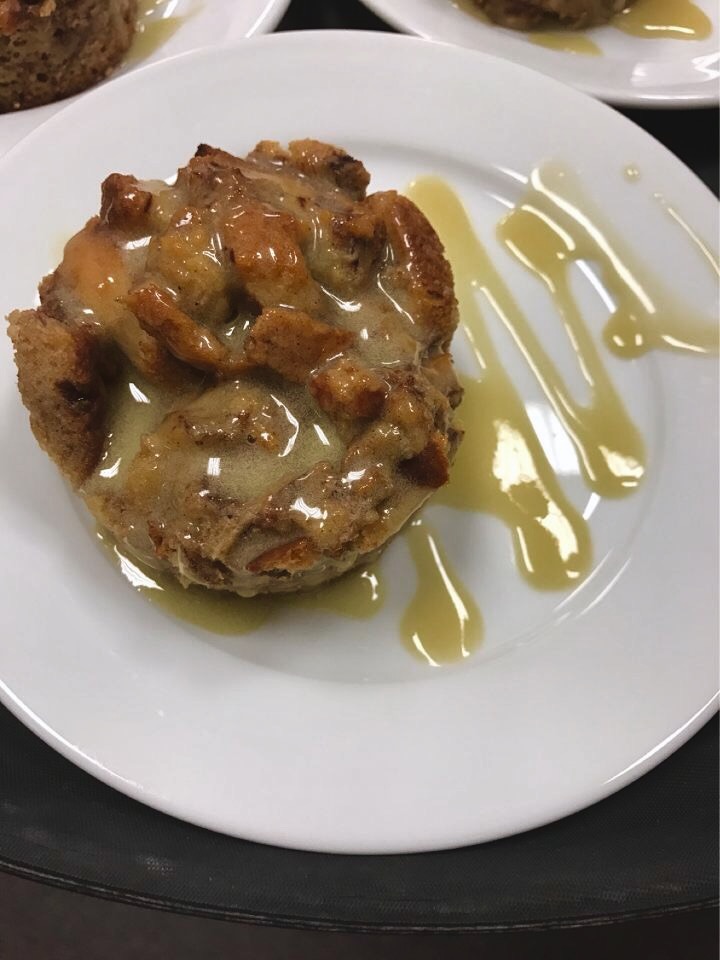 Stale bread works best, but my bread this week was too fresh again. So I popped it on a baking sheet and threw it in the oven at 350F until it was nice and toasted and a little browned around the edges. It absorbed my custard mixture without becoming too soggy, and this resulted in a much lighter and taller bread pudding.
However, Chef decided that my Caramel Whiskey sauce was probably too interesting for the folks in charge of the dinner because they wanted a very plain bread pudding with a very plain whiskey sauce. So we tested a plain whiskey sauce recipe to go along with my cinnamon bread pudding!

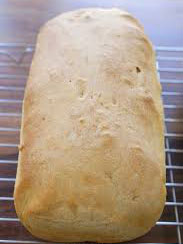
In addition to recreating my bread pudding, I also made a homemade bread loaf. This recipe was fairly easy; however, the proofing is a little time consuming.
Helpful Notes:
Although the process seems quite lengthy, all of the steps are important. Mixing results in an evenly distributed dough that is moistened and has air bubbles trapped inside which will later grow due to the gas from the yeast. Kneading is then done to make the proteins in the dough cross and form gluten sheets that provide elasticity to the bread. After kneading, proofing happens in which the yeast consumes the sugar and produces carbon dioxide and alcohol. This carbon dioxide is trapped by the gluten sheets formed during kneading, and thus causes the rising. The alcohol produced provides flavor to the bread, but both the alcohol and carbon dioxide evaporate during the baking process. Dough is then shaped according to the recipe. Dough is always placed smooth side down, onto a lightly floured surface. The more tightly the bread is shaped, the slower it will proof but it will result in a better shape and texture. After shaping the dough, it can be frozen for up to 2 weeks; however, the yeast’s performance may be slightly diminished. The best way to determine the doneness of bread is by checking the temperature. Most breads should be cooked to an internal temperature of 200 to 211F. Rich breads, however, should be cooked to 180 – 190F. It is also extremely important to properly cool bread on a wire rack so that air is allowed to circulate around the loaf. Bread should be cooled in the pan on a rack for 5 minutes, removed from the pan, and returned to the rack to completely finish cooling. Texture and flavor are improved with cooling.
ABC.
 allie in wonderland